Summary
Cosmos-Reason1: From Physical Common Sense To Embodied Reasoning
- 核心: 面向 Physical AI 的推理 VLM,通过 physical common sense 和 embodied reasoning 两类能力定义 + 专用 SFT/RL 训练,让多模态 LLM 具备物理世界理解与具身决策能力
- 方法: 定义 physical common sense(Space/Time/Physics 三类 16 子类)和 embodied reasoning(4 能力 × 5 agent 类型)两套 ontology;基于 Qwen2.5-VL-7B 和 Nemotron-H-56B 做 Physical AI SFT + GRPO RL,用 MCQ 形式的 rule-based verifiable reward
- 结果: SFT 阶段 embodied reasoning 提升 10%+,RL 阶段在 intuitive physics(arrow of time, spatial puzzle, object permanence)上从近随机提升至 81.5%
- Sources: paper | website | github
- Rating: 2 - Frontier(NVIDIA 推出的 Physical AI reasoning VLM,ontology + MCQ-RL 是有价值的范式,但 benchmark 自建自评、RL 规模有限、未成为领域 de facto 标准)
Key Takeaways:
- Ontology-driven 能力定义: 提出 physical common sense(3 大类 16 子类)和 embodied reasoning(4 能力 × 5 agent 类型)两套 ontology,为 Physical AI 评估建立了结构化框架
- Rule-based verifiable reward for Physical AI RL: 将 embodied reasoning 问题转化为 MCQ 格式,实现 rule-based 可验证奖励,绕过了 Physical AI 领域 reward design 的难题
- Intuitive physics 能力显著提升: 在 arrow of time、spatial puzzle、object permanence 等任务上,现有 VLM 几乎随机猜测,而 Cosmos-Reason1 通过 SFT+RL 将平均准确率从 42% 提升至 81.5%
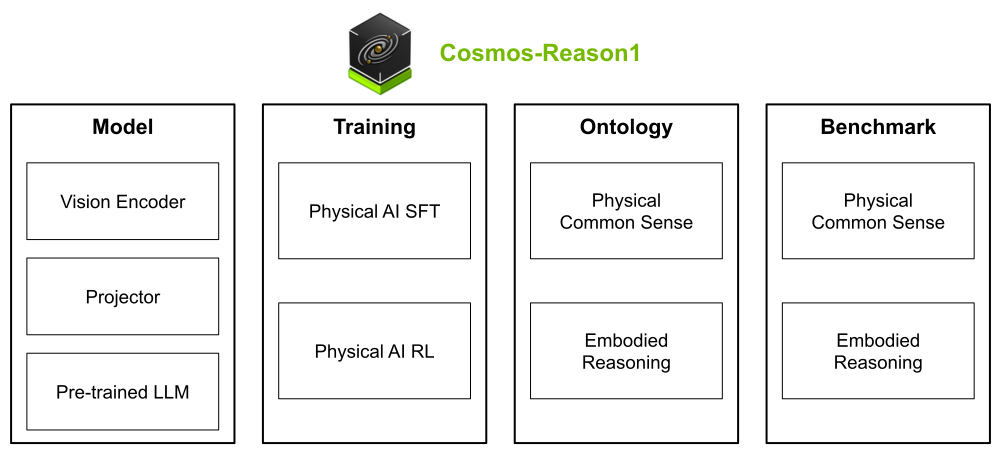
Teaser. Cosmos-Reason1 overview
Introduction
Physical AI 系统需要感知、理解并推理物理世界。当前 LLM 虽然在 coding 和 math 上推理能力强大,但在物理世界 grounding 方面存在关键局限——虽然通过海量文本可能获得了物理知识,但难以将知识与真实世界交互和动态联系起来。
Cosmos-Reason1 的核心思路:
- 定义 Physical AI 所需的基础能力(physical common sense + embodied reasoning)
- 提出两套 ontology 作为共享框架和评测标准
- 构建两个模型:Cosmos-Reason1-7B(基于 Qwen2.5-VL)和 Cosmos-Reason1-56B(基于 Nemotron-H)
- 两阶段训练:Physical AI SFT → Physical AI RL
- 探索用 MCQ 构建 rule-based verifiable reward 训练 Physical AI 推理
Figure 1. Cosmos-Reason1 整体流程

Physical AI Reasoning
Physical AI 推理包含两大能力:physical common sense reasoning 和 embodied reasoning。前者是 embodiment-agnostic 的环境理解,后者是面向具身决策的推理。两者都融合 System 1(快速直觉)和 System 2(慢速深思)的双系统思维。
Common Sense Reasoning
提出三层 ontology:
- Space: 物体间关系、空间合理性、affordance、环境理解(4 子类)
- Time: 动作理解、事件顺序、因果关系、相机运动、规划(5 子类)
- Fundamental Physics: 物体属性、状态变化、object permanence、力学、电磁学、热力学、反物理(7 子类)
Figure 2. Physical common sense ontology 饼图

Embodied Reasoning
提出二维 ontology,覆盖 4 种能力 × 5 种 agent 类型:
- 能力维度: Process Complex Sensory Inputs / Predict Action Effects / Respect Physical Constraints / Learn from Interactions
- Agent 维度: 人类、动物、机械臂、人形机器人、自动驾驶
本文聚焦前三种能力(Learn from Interactions 留作 future work),具体化为三个任务:
- Task-completion verification: 判断任务是否完成
- Action affordance: 评估某个 action 是否可行
- Next plausible action prediction: 预测下一步最合理的 action
Cosmos-Reason1
Multimodal Architecture
采用 decoder-only 架构(类似 LLaVA / NVLM-D):Vision Encoder → 2-layer MLP Projector(含 downsampling)→ LLM Backbone。
- Cosmos-Reason1-7B: 基于 Qwen2.5-VL,ViT-676M encoder,动态分辨率输入,dense Transformer backbone(28 层)
- Cosmos-Reason1-56B: InternViT-300M-V2.5 encoder + Nemotron-H hybrid Mamba-MLP-Transformer backbone(118 层),448×448 输入,最多 32 帧视频,PixelShuffle 2×2 下采样
Figure 3. 多模态 LLM 架构

Hybrid Mamba-MLP-Transformer Backbone
56B 模型使用 hybrid Mamba-MLP-Transformer 架构。Mamba 提供线性时间序列建模,少量 Transformer 层补充长上下文建模能力。
Figure 4. Hybrid Mamba-MLP-Transformer backbone 架构

训练并行策略:7B 用 TP=4,56B 用 TP=8 + PP=2。
Reinforcement Learning
Algorithm
采用 GRPO 算法(无需训练单独的 critic model)。优势函数通过在同一 prompt 的 response group 内归一化 reward 计算:
Equation 1. GRPO Advantage
符号说明: 为 response 的 reward, 为同一 prompt 生成的 response 组。
Training Framework
提出全异步 RL 训练框架,包含三个核心部分:
- Dispatcher: 调度训练数据、管理框架状态
- Actor Rollout: 从 prompt 生成 response,计算 reward 和 advantage
- Policy Training: 执行 GRPO,支持 5D 并行(DP, PP, CP, FSDP, TP)
关键优势:
- 异构部署策略(policy training 和 actor rollout 分离),相比 colocated 框架效率提升约 160%
- 节点故障时可快速重配继续训练,无需重启
- Dispatcher 冗余机制支持动态扩缩容
Figure 5. RL 训练框架架构

Data
Physical AI Supervised Fine-Tuning
总计约 4M 标注的 video-text pairs。SFT 数据分三大类:
Physical Common Sense VQA: 通过 5 阶段 pipeline 构建——视频策展 → 详细 captioning → QA pair 生成 → DeepSeek-R1 提取 reasoning trace → 清洗重写。包括 99K free-form understanding + 59.4K reasoning SFT,以及 1.2M MCQ understanding + 605K MCQ reasoning。
Embodied Reasoning: 聚焦 task-completion verification、action affordance、next plausible action prediction 三个属性。数据来源包括:
- BridgeData V2: 129.2K clips,robot manipulation
- RoboVQA: 218.5K clips,robot + human demonstrations
- AgiBot: 19.4K clips,humanoid robot manipulation
- HoloAssist: 136.3K clips,egocentric human manipulation
- AV: 12.4K clips,autonomous driving(人工标注 caption)
Figure 7. Embodied reasoning SFT 数据策展 pipeline(以 AgiBot 为例)

Intuitive Physics: 自监督构造的 SFT 数据
- Spatial Puzzles: 3K 视频 → 11K samples,将图片切为 2×2 patches 后打乱,模型推理正确空间位置
- Arrow of Time (AoT): 30K 视频 + 反转版本,判断视频播放方向
- Object Permanence: 10K clips(Libero 机器人仿真),判断物体是否违反 object permanence 消失
Physical AI Reinforcement Learning
RL 训练数据共 30,304 个 MCQ samples。Intuitive Physics 类数据天然适合 MCQ 格式且易于规模化;Common Sense 和 Embodied Reasoning 类数据通过人工转换为 MCQ,需要 human-in-the-loop 验证质量。
Benchmark
共构建 1,214 个评测问题(604 common sense + 610 embodied reasoning),全部为 MCQ 格式。
Physical Common Sense: 从 5,737 个候选问题中人工挑选 604 个(来自 426 个视频),覆盖 Space(13.25%)、Time(49.33%)、Fundamental Physics(37.4%)。
Figure 8. Common sense benchmark 问题类别分布

Embodied Reasoning: 6 个子 benchmark(BridgeData V2、RoboVQA、RoboFail、AgiBot、HoloAssist、AV),各 100 个问题。特别设计了 RoboFail 作为更困难的评测(需要高度观察力和 physical constraint 推理)。
Experiments
Physical AI Supervised Fine-Tuning
训练设置:7B 训练 12.5K iterations(lr 1e-5 → 1e-6 cosine),56B 训练 50K iterations(30K@1e-5 + 20K@1e-6),batch size 7B=256 / 56B=32。
Table 7. Physical common sense benchmark 结果
| Methods | Space | Time | Other Physics | Avg. |
|---|---|---|---|---|
| Gemini 2.0 Flash | 53.8 | 50.0 | 46.9 | 50.2 |
| GPT-4o | 61.3 | 54.7 | 50.9 | 55.6 |
| OpenAI o1 | 63.8 | 58.1 | 58.0 | 59.9 |
| Qwen2.5-VL-7B | 48.8 | 56.4 | 37.2 | 47.4 |
| Nemotron-H-56B | 61.3 | 68.1 | 45.1 | 58.2 |
| Cosmos-Reason1-7B | 54.2 | 58.7 | 50.0 | 54.3 (+6.9) |
| Cosmos-Reason1-56B | 61.3 | 65.5 | 53.9 | 60.2 (+2.0) |
Insights: 56B 略胜 OpenAI o1(60.2 vs 59.9),SFT 对 7B 模型提升最显著(+6.9)。
Table 8. Embodied reasoning benchmark 结果
| Models | BridgeData V2 | RoboVQA | Agibot | HoloAssist | AV | RoboFail | Avg. |
|---|---|---|---|---|---|---|---|
| Gemini 2.0 Flash | 25.0 | 78.2 | 29.0 | 44.0 | 37.0 | 67.0 | 46.7 |
| GPT-4o | 42.0 | 71.8 | 32.0 | 65.0 | 46.0 | 63.0 | 53.3 |
| OpenAI o1 | 42.0 | 80.0 | 44.0 | 63.0 | 37.0 | 61.0 | 54.5 |
| Qwen2.5-VL-7B | 38.0 | 82.5 | 40.4 | 50.0 | 36.0 | 57.6 | 50.8 |
| Nemotron-H-56B | 37.0 | 77.2 | 37.0 | 65.0 | 41.0 | 64.0 | 53.5 |
| Cosmos-Reason1-7B | 58.8 | 83.8 | 49.4 | 63.0 | 55.6 | 60.0 | 61.8 (+11.0) |
| Cosmos-Reason1-56B | 65.0 | 80.0 | 47.6 | 57.8 | 65.8 | 66.2 | 63.7 (+10.2) |
Insights: SFT 带来 10%+ 的 embodied reasoning 提升。两个模型均大幅超过所有 baseline,表明 domain-specific SFT 的有效性。
Physical AI Reinforcement Learning
RL 设置:batch size 128,每 prompt 采样 9 个 output,max length 6144 tokens,lr 4e-6,KL penalty 0.005,训练 500 iterations。
Table 9. SFT + RL 对比
| Models | Common Sense | BridgeData V2 | RoboVQA | Agibot | HoloAssist | AV | RoboFail | Avg. |
|---|---|---|---|---|---|---|---|---|
| Cosmos-Reason1-7B | 54.3 | 58.8 | 83.8 | 49.4 | 63.0 | 55.6 | 60.0 | 60.7 |
| + Physical AI RL | 56.2 | 73.5 | 86.8 | 54.2 | 60.0 | 67.0 | 62.0 | 65.7 (+5.0) |
Table 10. Intuitive physics benchmark 结果
| Models | Arrow of Time | Spatial Puzzle | Object Permanence | Avg. |
|---|---|---|---|---|
| Random Guess | 50.0 | 25.0 | 50.0 | 41.7 |
| Gemini 2.0 Flash | 50.0 | 31.0 | 48.0 | 43.0 |
| GPT-4o | 50.0 | 77.0 | 48.0 | 58.3 |
| OpenAI o1 | 51.0 | 64.0 | 49.0 | 54.7 |
| Qwen2.5-VL-7B | 50.2 | 27.2 | 48.8 | 42.1 |
| Cosmos-Reason1-7B | 56.0 | 85.4 | 82.0 | 74.5 (+32.4) |
| + Physical AI RL | 64.5 | 94.0 | 86.0 | 81.5 (+7.0) |
Insights: 最striking的结果——现有 SOTA VLM(GPT-4o, o1, Gemini)在 arrow of time 和 object permanence 上几乎等于随机猜测。Cosmos-Reason1 通过专门的 intuitive physics 数据显著提升,RL 进一步强化。RoboFail 表现停滞,作者归因于训练数据覆盖不足(需要 highly observant perception 和 complex affordance reasoning)。
关联工作
基于
- Qwen2.5-VL: 7B 模型的 backbone VLM
- Nemotron-H: 56B 模型的 hybrid Mamba-MLP-Transformer backbone
- DeepSeek-R1: reasoning trace 蒸馏来源 + GRPO 算法来源
- InternViT-300M-V2.5: 56B 模型的 vision encoder
对比
- GPT-4o, OpenAI o1, Gemini 2.0 Flash: 通用 VLM baseline
- Qwen2.5-VL-7B: 7B backbone 的 before/after 对比
- Nemotron-H-56B: 56B backbone 的 before/after 对比
方法相关
- GRPO: RL 算法(group-relative advantage,无 critic model)
- LLaVA / NVLM-D: decoder-only 多模态架构
- BridgeData V2 / RoboVQA / AgiBot / HoloAssist: embodied reasoning 训练数据来源
- Libero: object permanence 仿真数据来源
论文点评
Strengths
- Problem formulation 清晰且有价值: Physical AI 能力的 ontology 定义(特别是 physical common sense 的 16 子类)为领域提供了结构化的评测和训练框架,避免了 ad-hoc benchmark 的问题
- Intuitive physics 发现有信息量: 揭示现有 SOTA VLM 在 arrow of time、object permanence 上接近随机猜测,说明现有 benchmark 未能真正评估物理世界理解
- Rule-based verifiable reward 的 Physical AI 适配: 将 DeepSeek-R1 式的 MCQ reward 机制迁移到 embodied reasoning 领域,提供了一条可行的 RL post-training 路径
- 异步 RL 训练框架: 160% 效率提升和容错设计是工程上的实质贡献
- 开源: 7B 模型权重 + 代码 + 训练 recipe 开放,降低复现门槛
Weaknesses
- Benchmark 自建自评: 训练数据和评测 benchmark 均由同一团队构建,存在 evaluation bias 风险——ontology 定义的 capability 和 benchmark 的 question 分布可能天然偏向自己的训练数据分布
- RL reward 的局限: MCQ 格式的 rule-based reward 限制了 RL 训练的规模化和泛化——common sense 和 embodied reasoning 的 MCQ 数据量仅几千条,需要 human-in-the-loop,难以 scale
- 56B 模型缺少 RL 结果: RL 实验仅在 7B 上进行,56B 模型的 RL 收益未知
- Embodied reasoning 停留在语言层: 模型输出 natural language 的决策,未直接生成 action token,与 VLA end-to-end 范式有 gap。“next action prediction” 的准确率(BridgeData V2 最高 73.5%)离实际部署还有距离
- RoboFail 表现暴露泛化瓶颈: 作者坦承 RoboFail 上 SFT 和 RL 均无显著提升,说明模型在 OOD 的 hard cases 上泛化能力有限
可信评估
Artifact 可获取性
- 代码: inference + post-training(含 SFT 和 RL recipe)
- 模型权重: Cosmos-Reason1-7B(HuggingFace),56B 未公开
- 训练细节: 超参 + 数据配比 + 训练步数完整披露
- 数据集: SFT 数据基于公开数据集(BridgeData V2, RoboVQA, AgiBot, HoloAssist)+ 私有 AV 数据;RL 数据未直接开源但 recipe 公开
Claim 可验证性
- ✅ Physical AI SFT 提升 10%+: 有完整 benchmark 数字和 ablation
- ✅ 现有 VLM 在 intuitive physics 接近随机: 提供了 GPT-4o / o1 / Gemini 的评测数据
- ⚠️ “160% RL 训练效率提升”: 仅声明,未给出具体 wall-clock 对比数据
- ⚠️ Cosmos-Reason1-56B “略优于 OpenAI o1”: 差距极小(60.2 vs 59.9),且 benchmark 自建,统计显著性存疑
Notes
Rating
Metrics (as of 2026-04-24): citation=95, influential=11 (11.6%), velocity=7.2/mo; HF upvotes=50; github 936⭐ / forks=83 / 90d commits=0 / pushed 108d ago
分数:2 - Frontier 理由:属于 Physical AI reasoning VLM 的代表工作之一——NVIDIA 品牌效应 + 开源 7B 权重 + ontology 框架让它成为该方向的重要参考,Strengths 指出的 intuitive physics 发现和 MCQ-RL 范式有方法论贡献。但未达到 Foundation 档:benchmark 自建自评、RL 数据仅 3 万条难以 scale(Weaknesses 2)、56B 没 RL 结果(Weaknesses 3)、输出停留语言层没有闭环到 action(Weaknesses 4),整体更像一个能力探索而非 de facto 标准。高于 Archived 档的理由是方法并未过气,社区仍在引用其 ontology 和 MCQ-reward 设计作为 Physical AI reasoning 的参考点。2026-04 复核:citation=95 / velocity=7.2/mo、influential 比例 11.6%(略高于典型 10%)+ HF 50 upvotes + 936⭐ github 证明社区采纳稳步增长,但仍在 “前沿参考” 而非 “方向奠基” 量级,维持 Frontier。